
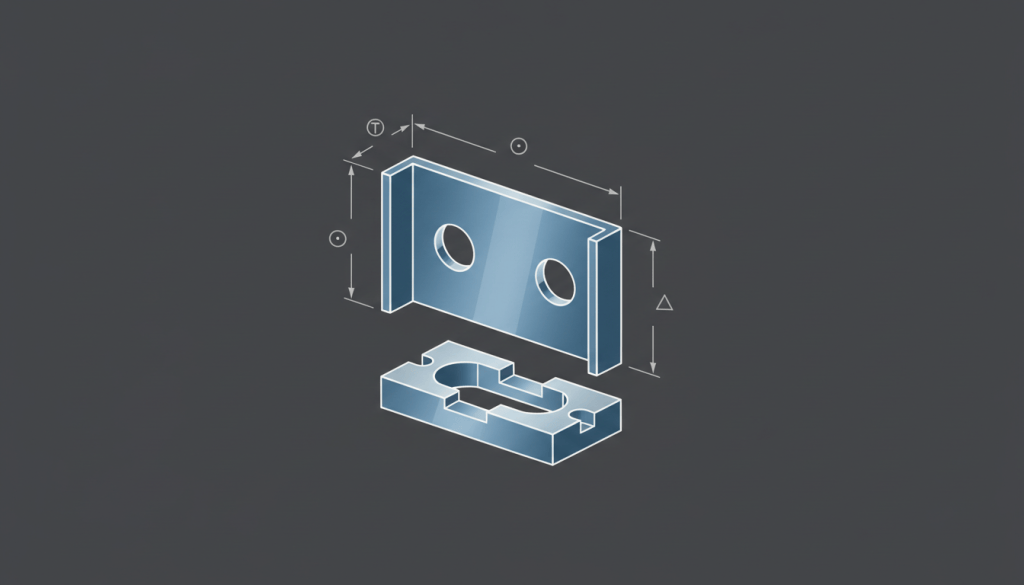
Metal stamping tolerances decide whether a stamped part fits, functions and passes inspection, and they are one of the biggest drivers of tooling and per-piece cost. This guide covers typical stamping tolerances by feature, why sheet metal stamping tolerances vary, and how to specify them on your drawing so the quote you receive matches what you actually need.
Key takeaways
- Blanked outlines and pierced holes are the most accurate stamped features, commonly around ±0.05 to ±0.1 mm.
- Bent and formed features are less predictable because of springback, commonly around ±1° to ±2° on angle and ±0.1 to ±0.2 mm on position.
- Tolerances tighter than the function needs add tooling adjustment, inspection time and scrap.
- Specify a general tolerance, then call out tighter limits only on critical dimensions.
Why sheet metal stamping tolerances vary
A stamped part is shaped by a die, so its accuracy depends on the die, the press, the material and the feature. Features cut in a single stroke, such as a blanked profile or a pierced hole, are usually the most accurate. Bent and formed features are harder to control: sheet metal springs back after bending, and the amount changes with material, thickness, bend radius and grain direction.
Metal stamping tolerance chart (typical ranges)
The ranges below are common industry values, not a guarantee for every part. Real capability depends on die design, material, thickness and part geometry, so always confirm against your drawing.
| Feature | Typical stamping tolerance |
|---|---|
| Blanked outline | About ±0.05 to ±0.1 mm |
| Pierced hole diameter | About ±0.05 to ±0.1 mm |
| Hole-to-hole position, same stroke | Tighter than features made in separate operations |
| Bend angle | About ±1° to ±2° |
| Bend position and formed height | About ±0.1 to ±0.2 mm |
| Burr height | Commonly kept to a fraction of material thickness, for example about 10% |
| Flatness | Depends on thickness, part size and material |
What drives stamping tolerance cost
- Tolerances tighter than needed. A limit that does not affect fit or function still adds die adjustment, inspection time and scrap.
- Features made in separate operations. Each extra station or setup adds variation. Where two features must align closely, say so, so they can be made in the same stroke of a progressive die.
- Bends near holes or edges. Forming distorts nearby features. As a rule of thumb, keep a hole a few material thicknesses away from a bend line.
- Very small holes. A common rule of thumb is a hole diameter of at least the material thickness for punching.
- Thin or soft materials. They distort more easily than thicker, stiffer ones such as stainless steel.
How to specify stamping tolerances on a drawing
- Set a general tolerance in the title block, then call out tighter tolerances only on the features that need them.
- Mark critical dimensions clearly so the supplier knows where to focus inspection.
- State the datum scheme for any position or flatness callouts.
- Give the material grade and thickness, since both affect what can be held.
- State the expected annual quantity. It decides whether a progressive die or simpler tooling makes sense, and that changes what is achievable per piece.
Stamping or CNC machining for tight tolerances?
If one feature needs more accuracy than stamping alone gives, it is often cheaper to machine just that feature afterwards, for example reaming a hole or milling a locating surface, than to force the die to hold it. A supplier that offers both metal stamping and CNC machining can quote the combined process as a single part.
Frequently asked questions
What is a standard tolerance for metal stamping?
A common general tolerance for stamped features is around ±0.1 mm, with tighter values such as ±0.05 mm possible on critical blanked or pierced features when the die is designed for it. Formed features usually need wider limits.
How tight can progressive die stamping tolerances be?
Progressive dies hold features made in the same stage very consistently, because they share one tool and one stroke. Features that depend on several stages, or on bending, vary more. Ask your supplier which features will be made together.
Why are bend tolerances wider than hole tolerances?
Bending causes springback, and the amount varies with material, thickness and grain direction. A punched hole has no such effect, so it can be held more tightly.
Does material choice change stamping tolerances?
Yes. Stiffer, thicker materials hold shape better; thin or soft materials distort more, and stainless steel springs back more than mild steel. Share the grade and thickness when you ask for a quote.
What information do I need to send for a stamping quote?
Send a drawing (PDF, DWG or STEP), the material and thickness, the annual quantity, and which dimensions are critical. That lets the supplier choose the right tooling and quote accurately.
Get a metal stamping quote for your part
Sha Run Industry is a metal stamping manufacturer in Ningbo, China, making custom stamped parts with our own tool room and CNC machining. Send your drawing, material, thickness and annual quantity, and tell us which dimensions are critical. We will review it and reply with a quote and any suggestions to reduce cost. Request a quote or read about our metal stamping capabilities.

